
How Stormwater Pollution Became A Clean Water Concern
October 18, 2012

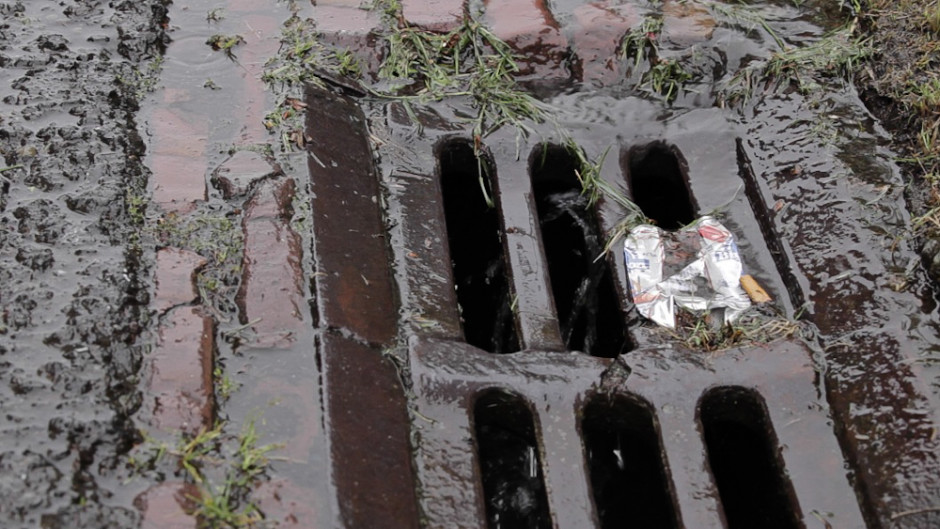
Stormwater runoff carries an assortment of litter and unseen pollutants into
rivers, lakes, and marine waters, including Puget Sound.
Credit: Katie Campbell/EarthFix
Work to develop solutions to the stormwater problem dates at least to the 1970s. Scientists, government officials and others woke up to the problem in a big way in the 1980s.

Fifteen years after adopting the Clean Water Act in 1972, Congress in 1987 amended the statute with directions for the U.S. Environmental Protection Agency to go after stormwater. But changing the law didn’t fix the problem.
Congress’ action prompted the EPA and its proxies at the state level to begin requiring cities to obtain government permits to operate the systems of gutters, pipes and so forth that dump the polluted stormwater into streams, rivers, lakes and bays. The local governments were required to:
- Educate the public about the problem and involve the public;
- Set up a program to catch people dumping contaminants down the stormwater system, such as people who route their sewage pipes into the system or dump oil and other pollutants into them;
- Develop a program to control stormwater flowing off construction sites;
- Make property owners control stormwater, usually through a system of “best management practices” that everyone is expected or legally required to follow, although these often are difficult to enforce;
- Make sure that government agencies are minimizing their contribution to the problem.
Those requirements kicked in for large cities and counties in the early 1990s and were extended to smaller local governments in 1999. But those requirements aren’t getting the job done, the EPA acknowledges. The agency is working on a proposal to better control stormwater, possibly through some kind of mandatory low-impact development requirement. The agency currently is scheduled to spell out its plans in June 2013.


Wealth & Poverty | February 2013
End of the Line
“It was just common knowledge – when you turn 18, you’re done,” Sharayah Lane said. “After the checks stopped coming, we all went our separate ways."
End of the Line is a new series by Claudia Rowe asking what happens when teens get too old for foster care in Washington State.
Photo Credit: Jon Connell/Flickr

Why So Few Rain Gardens,
and Other Questions
by Robert McClure
Watch: Stormwater Pollution
in Puget Sound
by Katie Campbell and Ashley Ahearn
Has Pollution Testing
Gone Astray?
by Robert McClure
Peter Maier's
One-Man Campaign
by Robert McClure
Where the Mayor Runs
the Treatment Plant
by Bonnie Stewart, EarthFix
Feminized Fish
Radio by Ashley Ahearn
The New Pollution: Toothpaste, Shampoo
and Drugs
by Cassandra Profita, Ecotrope
Tackling Agriculture,
The Biggest Polluter
by Robert McClure
Will Logging Roads be the
Next Target?
Radio by Amelia Templeton
Water Pollution Goals
Prove Elusive
by Robert McClure and Bonnie Stewart
Clean Water Act Penalties Map
by Jason Alcorn
More of 'The Next Act'
at EarthFix
by the Project Team

Environment | January 2013
Sharecroppers of the Sea
Meet America's newest sharecroppers. Guys like Jared Bright who vie for control of the Pacific fishing industry's lower rungs, the only rungs that seem to be left. They don't own the halibut, not even when it lands in their boats.
Lee van der Voo uncovers absentee landlords, brokers and bankers, and fish quota that costs more than your house — realities that fly in the face of more official, rosy portrayals.

Health | November 2012
The Mystery of MS
Kids with multiple sclerosis, historically an adult disorder, offer researchers a set of intriguing new clues about the disease that could lead, eventually, to better treatments.
With adolescent MS on the rise in the Northwest, Carol Smith meets a young patient who is learning to live with the disease at the age of 16, and the doctors and scientists trying to keep her healthy.

Environment | October 2012
Clean Water: The Next Act
In 1972, Congress enacted legislation to end water pollution. Forty years later, American rivers and lakes are still badly contaminated, and new threats to clean water are outpacing the Act's enforcers. Follow along as InvestigateWest and EarthFix investigate.

Immigration | September 2012
Center of Detention
The Northwest Detention Center in Tacoma, Wash., generates millions in revenue for its private operator by processing thousands of deportation cases each year. Oscar Estrada is one of those cases.

Environment | June 2012
Parks for Sale
As local governments trade away public parkland, the safeguards put in place by the Land and Water Conservation Fund to protect that land are full of holes.
Robert McClure tracked a handful of park conversions for more than three years, reviewed thousands of pages of documents and compiled a database of over 40,000 park grants.

Public Health | January 2012
The Prescription Epidemic
As Washington enacts the strongest prescription drug law in the country, InvestigateWest presents a six-month investigation into the origins of the prescription epidemic, the challenge it poses for communities, and what lessons other states might learn.
Check out the full list of news outlets publishing the story, and visit KCTS.org to watch Prescription for Abuse, a KCTS 9/InvestigateWest documentary and roundtable with prescription drug experts.